Three contact centres. Three different AI voice implementations. One spectacular success, one modest win, and one expensive failure that's now quietly being unplugged.
The difference? Not the technology. Not the budget. It was knowing which conversations to automate and which to leave alone.
The Reality Behind the Hype
AI voice agents can handle thousands of calls simultaneously, never take breaks, and cost roughly £0.08 per conversation. For specific use cases, they're remarkable. But here's what the sales pitches won't tell you: most contact centres that deploy AI voice agents see them handle about 35-40% of intended call types successfully. The rest get escalated to humans anyway.
That's not a technology problem. It's a mismatch problem.
Where AI Voice Agents Actually Work
Appointment booking and rescheduling. We've seen dental practices reduce admin time by 60% with AI handling appointment changes. The conversation structure is predictable, the data is simple, and patients don't care whether it's a human or AI reading back their time slot.
Account balance and payment status queries. Financial services are having real success here. "What's my balance?" is a bounded question with a bounded answer. No judgement calls required.
First-level triage for technical support. "Have you tried turning it off and on again?" actually works better with AI because it doesn't get impatient. The agent can walk through diagnostics without ego, then hand off to a human when it hits its limits.
Order tracking. E-commerce companies are seeing 80%+ automation rates for "where's my package?" calls. It's information retrieval, not problem-solving.
Where They Fail
Billing disputes. We watched a telecoms provider try to automate this. Disaster. Customers were already angry, the AI couldn't understand context ("I was charged twice" vs "I shouldn't have been charged at all"), and escalation wait times doubled because humans were handling the aftermath of failed AI conversations.
Complex product questions. If your customer is choosing between three service tiers with different features, the AI will recite specifications. A good human will ask what they're trying to achieve and recommend accordingly. There's a reason B2B sales don't happen via chatbot.
Emotionally charged situations. Complaints, cancellations, service failures. AI voice agents can recognise anger in tone but can't navigate it effectively. They don't build rapport and they can't apologise in a way that feels genuine.
Anything requiring judgement. "Can I return this even though it's past 30 days?" needs a human decision. AI agents either say no rigidly (alienating customers) or escalate (defeating the purpose).
The Honest Cost Calculation
Let's talk numbers for a 50-seat contact centre considering AI voice:
Setup costs: £25,000-45,000 for platform integration, call flow design, and testing. Expect 3-4 months to deployment.
Per-conversation costs: £0.05-0.12 depending on complexity and provider. Seems cheap until you realise escalated calls now take 40% longer because the customer has already explained their issue once.
Hidden costs: Additional QA resource (someone needs to listen to failures and refine the flows), customer frustration when AI doesn't understand regional accents or colloquialisms, and reputational risk if your AI becomes a social media meme.
One mid-sized insurance company calculated they'd break even at 12,000 calls per month. They're currently at 8,000 because customers are increasingly choosing the "press 0 for human" option after one bad experience.
What Works: Hybrid Models
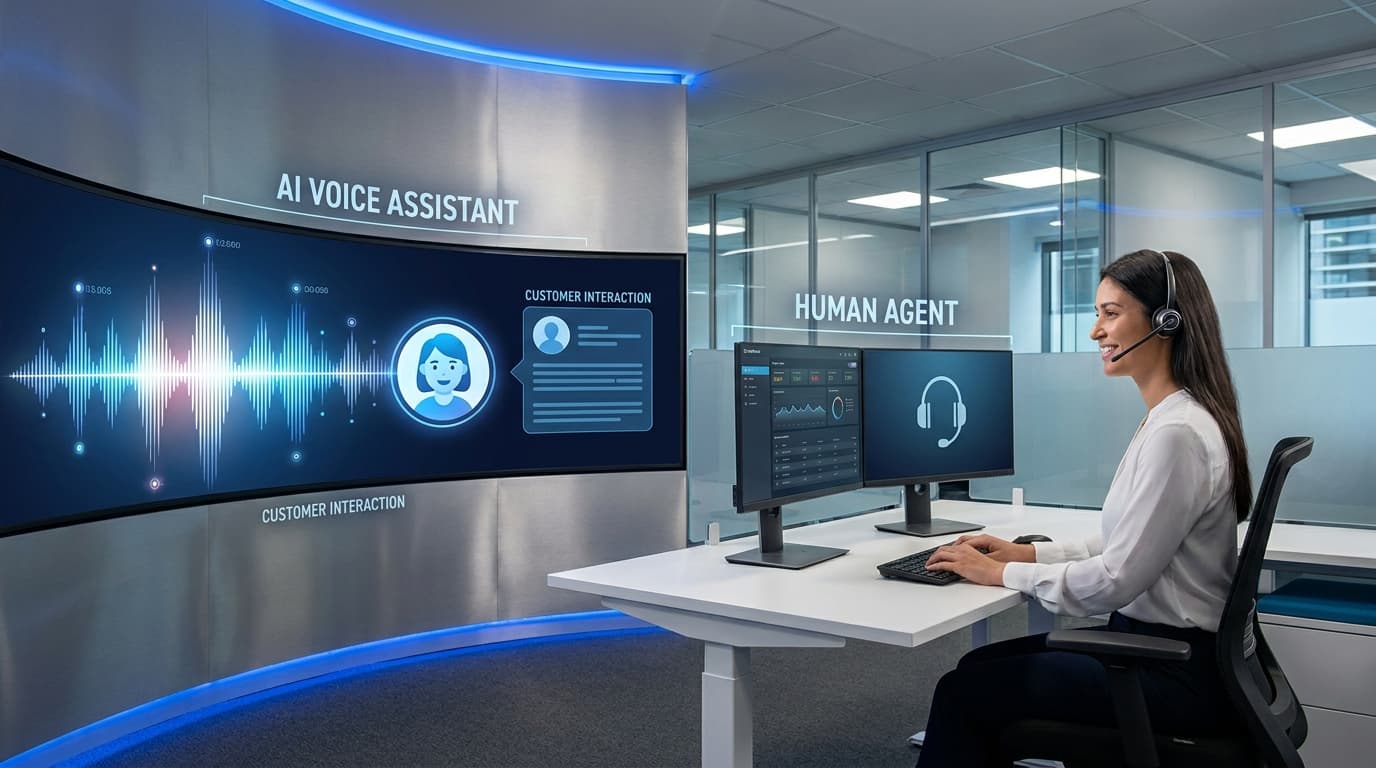
The contact centres getting this right aren't choosing AI or humans. They're deploying both intelligently.
A utilities company we work with uses AI for the first 60 seconds of every call. It identifies the caller, pulls up their account, asks the initial question, and routes to the right department. Human agents then pick up mid-conversation with full context. Average handling time dropped by 90 seconds, and customer satisfaction increased because they're not repeating themselves.
Another approach: AI handles the call completely, but a human monitors in real-time and can take over within 2 seconds. It's like training wheels. The AI gets most calls right; the human catches edge cases.
Three Questions Before You Deploy
1. Can you write down the exact decision tree? If the conversation has more than 8-10 decision points, or if those decisions require interpretation, you're not ready for AI voice. Start with simpler processes.
2. What's your escalation rate assumption? If you're planning for under 20%, you're being optimistic. Budget for 30-40% initially.
3. How will you measure success? It's not just automation rate. Track customer satisfaction separately for AI-handled vs escalated calls. If escalated calls have significantly lower CSAT, your AI is poisoning the well.
The Verdict
AI voice agents are brilliant for high-volume, low-complexity interactions. They're hopeless at nuance, emotion, and complexity. Most contact centres should deploy them for 20-30% of call types and let humans handle the rest.
The technology will improve, but so will customer expectations. Three years from now, we'll likely see AI handling 50-60% of calls effectively. Right now? Pick your battles, monitor closely, and don't fire your human agents just yet.
If you're exploring AI voice for your contact centre and want a honest assessment of what'll work for your specific call types, that's a conversation worth having. With a human.