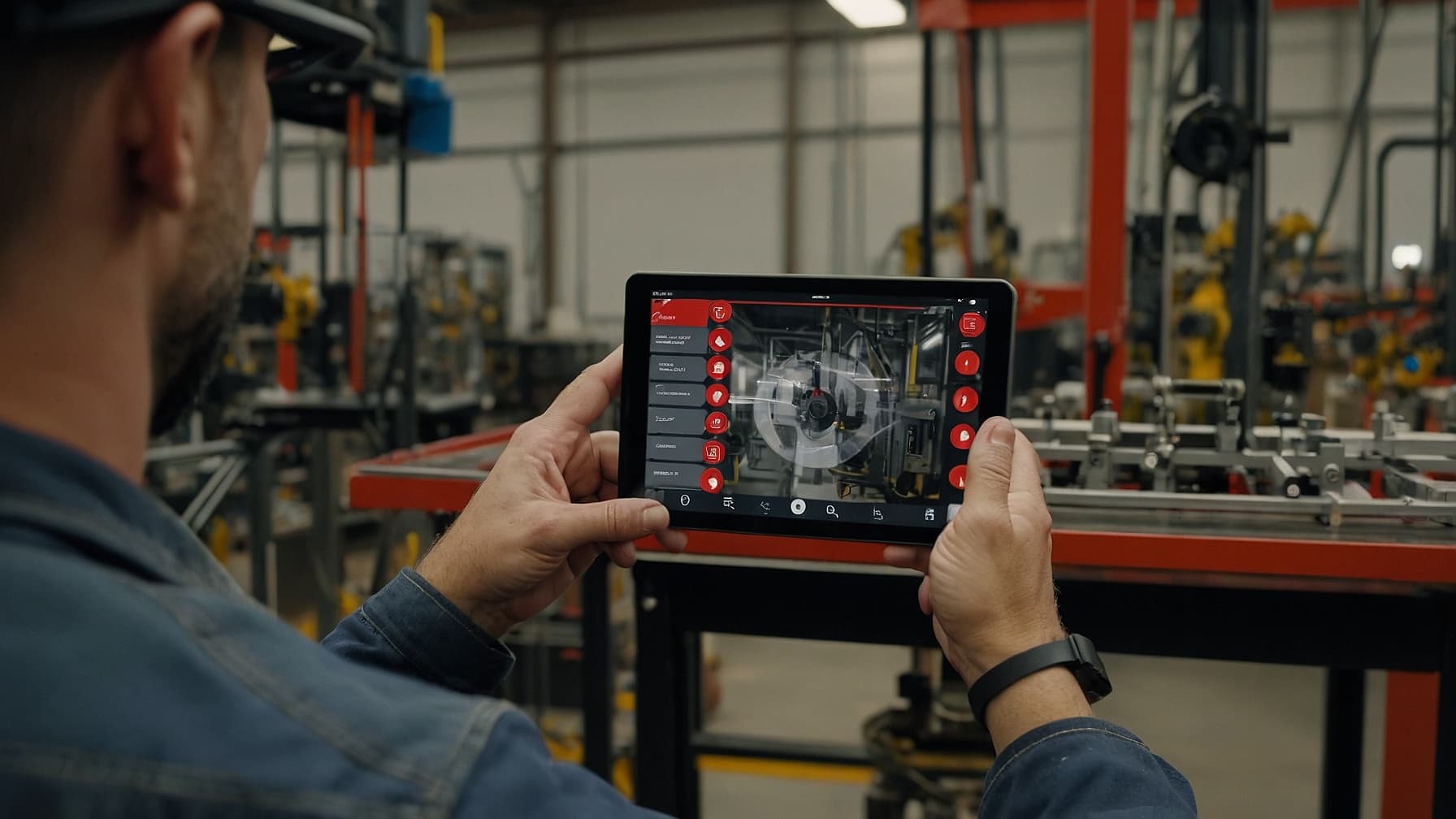
As someone who has worked remotely for years, I know firsthand the value of video meeting apps for staying in touch with colleagues and clients. However, remote visual assistance represents a different type of tool that takes remote communication and collaboration to the next level. In this article, we'll explore the primary differences between remote visual assistance and regular video meeting apps like Zoom, Teams, WhatsApp and Google Meet.
Primary Differences Between Remote Visual Assistance and Regular Video Meeting Apps
We'll explore how remote visual assistance provides enhanced communication through the use of AR tools, a hands-on visual approach for problem-solving, and benefits for education and training purposes. We'll also examine the cost savings that come with minimising travel, and the potential for improved customer support and increased productivity through real-time guidance and centralised data management.
Enhanced Real-Time Communication Through AR Tools
AR tools enable enhanced and real-time communication, improving remote collaboration. With AR overlays, remote visual assistance offers a hands-on approach to solving problems that video meeting apps lack. This tool is beneficial for education and training purposes as well. Moreover, remote visual assistance minimises travel cost and increases productivity through real-time guidance. Centralised data management also provides efficient access to information.
Remote visual assistance delivers a more immersive and interactive experience for users, leading to expedited problem-solving through the use of AR annotations. Remote observation provided by AR technology allows first-hand knowledge sharing in an education or training setting that is unmatched by video meeting apps. Additionally, it saves costs since reduced travel needs are met with better customer service through AR overlays.
Furthermore, delivering increased productivity through real-time guidance while improving data management for enhanced collaboration yields enormous benefits in most industries like healthcare, IT and manufacturing.
Hands-On, Visual Approach for Problem-Solving
A practical and interactive approach to problem-solving is critical for businesses in today's digital world. This method can be achieved through a hands-on, visual approach for problem-solving, which has several benefits over conventional video meeting apps.
Here is a four-step guide to achieving this hands-on, visual approach for problem-solving:
- Use remote visual assistance tools with augmented reality (AR) overlays to improve communication with team members and customers.
- Provide real-time support by using AR annotations during troubleshooting sessions.
- Conduct training sessions remotely by allowing trainees to observe activities in real-time through AR technology.
- Create central data management mechanisms to improve collaboration among team members and data accessibility.
One of the unique benefits of this approach is that team members can observe activities as they happen on-site, thus promoting first-hand observation of events. Such an immersive experience accelerates knowledge acquisition in a manner unachievable by traditional video conferencing applications.
Benefits for Education and Training Purposes
Remote visual assistance offers numerous benefits for education and training purposes. Through augmented reality tools, users can receive hands-on guidance and real-time communication that enhances problem-solving skills. The following points highlight the advantages of remote visual assistance:
- More immersive and interactive experience
- First-hand observation for education and training
- Cost savings through reduced travel expenses
- Improved productivity through real-time guidance
With remote visual assistance, individuals can receive personalised attention from experts across the globe, regardless of their physical location. This technology minimises travel costs and saves time without sacrificing its effectiveness.
One unique advantage is that AR overlays provide an improvement in customer service by solving issues quickly and efficiently. Instead of relying on verbal descriptions or text messages to convey problems, customers can share visual information with remote experts.
Cost Savings Through Minimising Travel
By minimising the need for travel, remote visual assistance provides significant cost savings for businesses and individuals alike.
- Remote visual assistance allows experts to provide guidance from remote locations, eliminating the need to travel to a physical location. This reduces costs associated with transportation, lodging, and other related expenses.
- By reducing travel, remote visual assistance also saves time, which can be devoted to more productive activities or spent on personal pursuits.
- In addition to cost savings from reduced travel expenses, remote visual assistance can also result in improved efficiency and productivity.
- Centralised data management systems used in remote visual assistance can reduce duplication of efforts and make collaboration easier. This enhances overall productivity while also ensuring that important data is always accessible when needed.
Beyond simple cost savings through reduced travel expenses, using a remote visual support platform can uniquely benefit businesses and individuals by providing broader collaborative opportunities.
Improved Customer Support Through AR Overlays
Through the use of AR overlays, remote visual assistance provides improved customer support by allowing experts to guide customers in real-time. These overlays enable experts to easily highlight and label parts or steps, making it easier for customers to follow the guidance provided. Additionally, AR tools allow for collaborative annotations that can be viewed remotely, so multiple team members can work together on a single issue.
Moreover, remote visual assistance uses AR technology to improve customer support by providing a more engaging and interactive experience. With the increased immersion offered by this technology, customers feel more connected with the expert providing support. This increased engagement has been shown to lead to greater customer satisfaction and loyalty.
In addition, remote visual assistance further benefits customer support by offering clear and concise instructions that reduce the amount of time required for issue resolution. Through AR overlays and guided problem-solving techniques, experts are able to quickly demonstrate solutions that minimise confusion and frustration.
Increased Productivity Through Real-Time Guidance
Real-time guidance has been proven to drive productivity at a faster pace than traditional means of communication.
- Visual instructions and demonstrations imparted via remote visual assistance tend to be more efficient, timely, and accurate than written or verbal instructions.
- AR overlays help in highlighting specific areas of focus, thereby reducing the chances of errors and rework and minimising the time required for problem-solving.
- Collaborative features ensure that multiple stakeholders can participate in real-time and coordinate efforts. Live monitoring also ensures that all parties remain on the same page.
- Remote visual assistance enables faster decision-making through real-time guidance. The expert can promptly intervene as needed to correct mistakes and highlight best practices by doing so instantly within the session itself.
- Instant feedback loops reduce trial-and-error techniques and increase the speed of execution as individuals can ask questions as they work with little to no delay time.
- The ability to search data quickly is available, ensuring that essential information is available sooner without too much navigating or searching.
The immersive experience provided by remote visual assistance is known to increase innovation, creativity, and improve mental clarity, overall leading to increased productivity when used consistently.
Centralised Data Management for Improved Efficiency and Access
Remote visual assistance offers a centralised data management system for improved efficiency and access. The system enables real-time storage, retrieval, and sharing of all kinds of data, such as images, videos, and documents. By doing so, it eliminates the need for physical storage spaces or time-consuming searches through multiple sources.
More importantly, remote visual assistance provides secure access to information from anywhere in the world. All parties involved can collaborate on a project regardless of their location, device or operating system. Data stored in real-time is easily accessible by team members who need to make changes or follow-up on progress made. Ultimately, this centralisation of data increases productivity through efficient use of time and resources.
Another advantage of remote visual assistance in centralised data management is that it improves employee training processes. With easy accessibility to information, remote teams learn more about company practices increases their speed in adapting these practices across multiple locations.
Finally, centralised data management reduced the likelihood of errors since it helps avoid duplication or loss of important documents. Also, constant back-ups ensure that data never gets lost - this has saved organisations significant amounts of money by eliminating risks which could have otherwise resulted in costly lawsuits.
Advantages of Remote Visual Assistance
After researching the topic, I discovered several advantages that set remote visual assistance apart from traditional video meeting apps. The benefits of remote visual assistance include:
- More immersive and interactive experience - By using remote visual assistance, users can experience a more immersive and interactive environment compared to traditional video meeting apps, due to the integration of augmented reality (AR) tools.
- Expedited problem-solving through AR annotations - Remote experts can provide audio and visual feedback to guide technicians through processes collaboratively.
- First-hand observation for education and training - This allows for a more practical learning experience centered around real-world scenarios rather than theoretical examples.
- Cost savings through reduced travel - Remote visual assistance reduces the number of trips that must be made, decreasing travel times and expenses.
- Better customer service through AR overlays - Support representatives can visually guide customers through each step, increasing satisfaction and reducing support time.
- Increased productivity through real-time guidance - Technicians can acquire new skills more quickly with expert guidance available in real-time.
- Improved data management - Centralised systems simplify access for all team members and enhance collaboration.
Conclusion: Remote Visual Assistance as the Future of Digital Communication and Collaboration
Remote visual assistance has emerged as an innovative technology, revolutionising the way we interact digitally. It is the future of digital communication and collaboration that will enable us to work, communicate, and collaborate effectively without any physical boundaries. With the ability to share real-time visuals, remote visual assistance provides an interactive experience that regular video meeting apps cannot match.
Using remote visual assistance, individuals can receive instant help and guidance, eliminating the need for physical presence. The technology enhances virtual communication through its ability to share and annotate live visuals, making it an invaluable tool for businesses and professionals to collaborate remotely.
With remote visual assistance, users can solve issues faster, improve productivity, reduce costs, and enhance customer experience. The technology can be used in various industries, including healthcare, manufacturing, and logistics, to name a few.
The technology has been around for over a decade, and it has continuously evolved, incorporating advanced capabilities and features that make it even more valuable as the future of digital communication and collaboration.