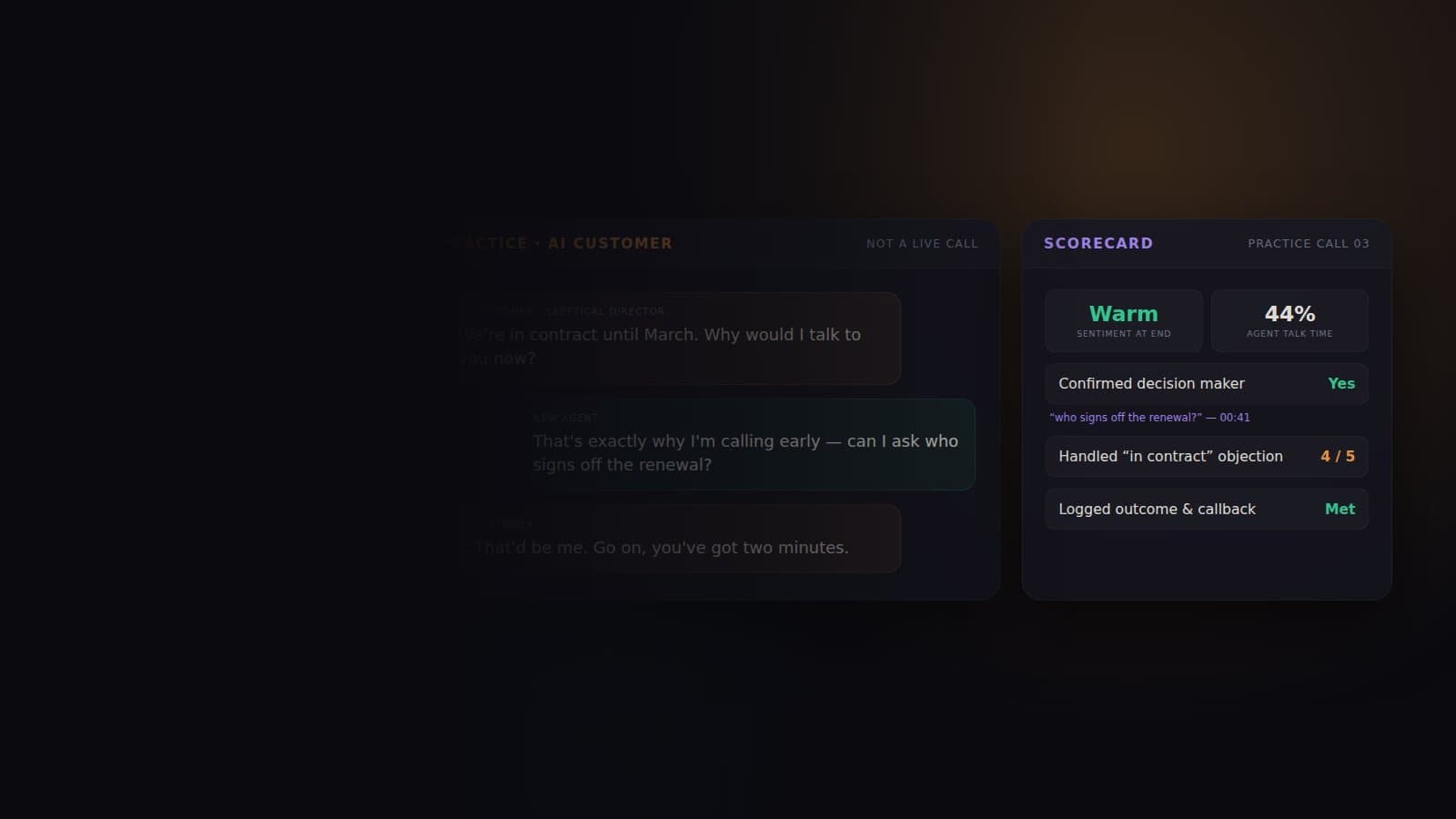
Most outbound teams still train new agents the same way: a few hours on the product, a printed script, a role-play with whoever is free, and then a live list. The agent's first real objection comes from a real prospect, and that prospect is usually lost.
AI practice customers change the order. The agent's first hundred conversations happen with an AI that plays a realistic customer, inside the same dialer, with the same script and the same wrap-up form. Nobody real is called, and nothing on your list is burned.
With roughly a third of agents leaving each year, training never stops. The question is whether new starters learn on your leads or on something built for learning.
What an AI practice customer is
An AI practice customer is a scenario you define: a friendly small-business owner who is ready to buy, a skeptical operations director who is still in contract, an office manager who isn't the decision maker and won't put you through. Each one has its own personality, objections and made-up account details, so the agent has something real to qualify.
The useful part is that the AI reacts to how it is treated. It warms to an agent who is clear and honest about why they're calling, and it pushes back on one who is pushy or vague. Practice that only rewards reading the script word for word doesn't prepare anyone for a real gatekeeper; practice that responds to tone does.
In Connecta, admins add scenarios under Settings → AI practice customers, and agents start a session from My queue → Practise with an AI customer.
Benefit 1: agents rehearse the real script in the real workspace
A role-play with a colleague happens away from the tools. The agent never practises finding the right field, logging the outcome or reading the script while someone talks over them.
A practice call in Connecta behaves exactly like a live call: hold music, the on-screen script, the call recording and the outcome form at the end. The agent learns the conversation and the screen at the same time, which is where most first-week mistakes come from.
Training that happens in a different tool from the one agents use on live calls teaches the words but not the workflow. Practice inside the dialer teaches both.
Benefit 2: test a campaign end to end before it goes live
The same path that trains agents also tests the campaign. Before you load a new list, a supervisor can run a practice call through it and check every step that a real prospect would hit.
| What to check | How a practice call shows it |
|---|---|
| Script | Does each step read naturally out loud, and does it branch where it should? |
| Screen-pop and fields | Does the right record appear, and are the fields the agent needs there? |
| Recording | Is the call recorded, and does the recording announcement play when it should? |
| Outcomes | Does every outcome button write back to the dialer (and your CRM) correctly? |
| Wrap-up | Is the wrap-up form quick enough that agents won't skip it? |
Connecta also has built-in test numbers for checking the rest of the call path end to end, so the first real dial of a new campaign is not its first test.
Benefit 3: see how your call path treats a human "hello"
Answering-machine detection is one of the hardest parts of outbound to get right. Every time it labels a real person as a machine, someone picks up to silence.
Because a practice customer answers the way a person would, a practice call shows you how the call path behaves when a human greets the agent. Connecta's AMD rules page then shows each phrase the detector listens for, how often it decided a call, whether your agents agreed, and its measured precision. A rule that keeps calling real people a machine on your traffic can be set to Weak (still logged, never hangs up on its own) or Off.
Ask us to confirm which AMD checks apply to your setup before relying on practice calls for AMD testing.
Benefit 4: a shorter learning curve, with evidence
Practice is most useful when there is feedback afterwards. Because practice calls are recorded and wrapped up like any other call, they can be reviewed the same way:
- During the call, Agent Assist transcribes live and shows tips.
- After the call, a summary pre-fills the wrap-up notes.
- With Interaction Analytics on, your scorecard is answered with the transcript line as evidence: did they confirm the decision maker, handle the price objection, give the opt-out correctly? Click the quote and the recording jumps to that moment.
That turns coaching from "how do you think it went?" into "here is the line, let's listen to it."
| Role-play with a colleague | Standalone AI training tool | Practice inside the dialer | |
|---|---|---|---|
| Uses your real script | Usually | If you load it | Yes |
| Uses the real agent screen | No | No | Yes |
| Recording and outcome form | No | Varies | Yes, same as a live call |
| Tests the campaign too | No | No | Yes |
| Needs a second person | Yes | No | No |
A simple first-week plan
- Day 1: product and compliance basics, then three practice calls against the easiest scenario.
- Day 2: the skeptical, in-contract scenario until the agent can get to a next step without arguing.
- Day 3: the gatekeeper scenario; practise asking for the named contact and booking a callback.
- Day 4: review two recorded practice calls with a supervisor, using the scorecard.
- Day 5: live calls on a warm list, with Agent Assist on and supervisors able to listen and whisper.
Adjust the scenarios to your market: an energy broker's skeptical director worries about contract end dates, a solar installer's homeowner worries about the roof.
Questions teams ask
Does a practice call ever reach a real person?
No. Each practice number connects the agent to an AI playing the customer. Nobody real is called, and the call is recorded and wrapped up like any other so it can be reviewed.
Can we write our own scenarios?
Yes. Admins create scenarios under Settings → AI practice customers, each with its own personality, objections and made-up details such as current supplier or contract end date.
Does practice replace coaching?
No. It gives coaches something concrete to work from: a recording, a transcript and scorecard answers with the evidence quoted.
Is this only for new starters?
No. Experienced agents use it to rehearse a new script or a new product before a campaign launches, and supervisors use the same path to test the campaign itself.
See an AI practice customer push back on a cold opener, then watch the scorecard explain why.
Contact us for a 20-minute walkthroughSources: ContactBabel, The US Contact Center Decision-Makers' Guide 2024 (16th edition), pp. 17–20: mean annual agent attrition 31% and median 24% at year-end 2023; staffing "up to 75%" of operational cost. Product details: Connecta.