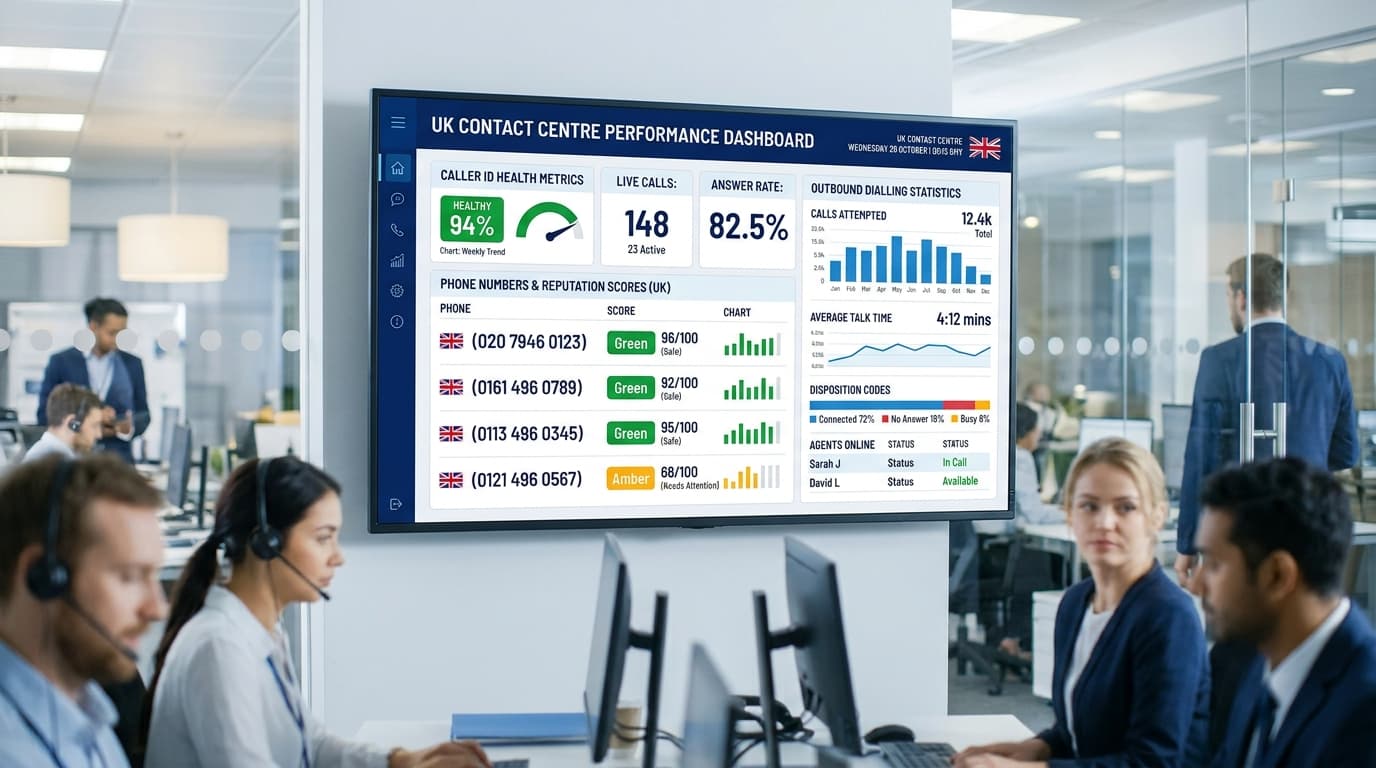
Choosing a UK outbound dialler in 2026 means balancing six critical requirements: low-failure-rate answering machine detection (AMD), call screener management, easy DID ordering and deployment, caller ID health analysis and alerting, calling behaviour pattern management (rotation, localisation, avoiding overcalling), and registration with Hiya and Truecaller. No single resource addresses all six with UK-specific Ofcom and TPS context — until now.
Why These Six Features Matter Now
Call screeners on smartphones have become aggressive gatekeepers. Carriers apply spam labels to numbers based on calling behaviour, not malice. Voicemail systems detect predictive dialler patterns and drop calls before they ring. In this environment, a dialler that worked in 2020 will fail in 2026 without these six capabilities working together.
Ofcom's 2016 persistent misuse policy removed the explicit 3% abandoned call rate limit but made enforcement more nuanced. The regulator now examines your reasoning, your AMD accuracy estimates, and whether you can demonstrate control over false positives. Since February 2026, the ICO's PECR fining powers match UK GDPR levels, putting real financial risk behind TPS screening failures and withheld caller IDs. Meanwhile, Hiya's caller reputation platform now reaches over 95% of UK mobile subscribers through carrier integrations with EE, Virgin Media O2, and Samsung devices.
The honest answer: if your dialler can't prove low AMD failure rates, manage caller ID reputation in real time, and register numbers with Hiya, your answer rates will drop — and Ofcom notices patterns before you do.
1. Low-Failure-Rate AMD (Answering Machine Detection)
Ofcom effectively discouraged AMD use in 2008, stating that "at present, and until accuracy rates improve, it will be very difficult to use AMD technology without breaching the three per cent guideline." The technology has improved, but the bar remains high. A false positive — mistaking a person for a machine and disconnecting — counts as an abandoned call. If your AMD fails 5% of the time on a 10,000-call campaign, that's 500 silent calls to real people.
Contact-Pro's AMD maintains a false-positive rate consistently below 2% through dual-layer detection: initial frequency analysis identifies UK digital voicemail tones, followed by speech pattern recognition that distinguishes human pauses from recorded messages. The system adapts to regional accents and learns from agent feedback when calls are manually overridden.
Ask any vendor for their reasoned estimate of AMD false positives, as Ofcom requires. If they can't provide it with supporting data, assume their technology hasn't kept pace.
2. Call Screener Management
Call screening apps — native iOS features, Google's Call Screen, third-party tools — now ask "why are you calling?" before connecting. Some intercept silently and drop calls that exhibit dialler timing patterns: precisely timed bursts, sub-second connection delays, or repeated attempts within narrow windows.
Managing call screeners means two things. First, agent connection must happen within two seconds of answer, with no dead air — Ofcom's requirement, but also the threshold below which screeners treat calls as legitimate. Second, calling patterns must avoid the signatures that trigger automated rejection: identical inter-call intervals, mechanical pacing, or calls that always land within the same five-minute window each day.
Contact-Pro's intelligent pacing introduces microsecond-level randomisation to call timing, connects agents before the recipient hears ringing using persistent connections, and allows manual dial-through for high-value contacts that have previously screened calls. The platform tracks which numbers have engaged call screening and adjusts retry logic accordingly.
3. DID Easy Ordering and Deployment
You need multiple DIDs — Direct Inward Dial numbers — for rotation, localisation, and segregating campaigns. Legacy telecoms suppliers treat DID provisioning as a procurement exercise: submit a form, wait three to seven days, receive numbers in batches, then configure them manually. By the time you have numbers, the campaign is stale.
Contact-Pro provisions DIDs within 24 to 48 hours for standard UK geographic and 03 numbers, sourced directly from Ofcom-regulated carriers with API integration. The platform's self-service portal lets you request numbers by area code, assign them to campaigns, and configure caller ID presentation without touching a switch. Need 20 Manchester numbers for a localised social housing campaign? Request them Tuesday morning, deploy them Wednesday afternoon.
For compliance, all DIDs are validated as dialable and in-service before assignment, meeting Ofcom's January 2025 caller ID guidance that requires presented numbers to accept inbound calls.
4. Caller ID Health Analysis & Alerting
Your number's reputation degrades before your answer rates drop. By the time you notice fewer connections, carriers have already labelled your DIDs as "Potential Spam" or "Scam Likely" — labels that most recipients never answer. Reactive monitoring doesn't work; you need real-time visibility into how networks and apps perceive your calling numbers.
Caller ID health tracking monitors three critical metrics. Spam score aggregates signals from carrier algorithms, crowdsourced reputation databases (Hiya, TNS, First Orion), and complaint patterns. A number that starts the week clean can reach "high-risk" status within 200 calls if calling behaviour triggers flags — short call durations, high abandonment clustering, or repeated attempts to the same unsuccessful numbers. Label status tracks what recipients actually see when your number calls: "Unknown", "Spam Risk", or worse, explicit scam warnings. Answer rate trends measure change over time; a 15% drop week-on-week signals reputation damage even if absolute rates look acceptable.
Contact-Pro's caller ID health dashboard polls Hiya, Truecaller, and TNS APIs every four hours for all active campaign DIDs, flagging degradation before it affects performance. When a number crosses into "high risk" territory — spam score above 60 on a 100-point scale, carrier labelling detected, or answer rates down 20% from baseline — automated alerts notify campaign managers via email and in-platform notifications. The system recommends immediate rotation to a clean number and quarantine of the flagged DID for reputation recovery.
Ofcom expects you to monitor calling patterns that might constitute persistent misuse. Real-time caller ID health tracking provides the evidence base to demonstrate control — and catches problems while you can still fix them.
5. Calling Behaviour Pattern Management
Carriers don't care about your intent. They care about observable patterns. Call the same postcode repeatedly within a two-hour window using the same DID, and you'll trigger spam filters regardless of TPS compliance. Overcall a contact six times in three days, and their network starts blocking your numbers proactively. Localised DIDs only help if you actually rotate them intelligently.
Effective calling behaviour management requires four interconnected controls. Number rotation distributes outbound calls across multiple DIDs to prevent any single number from accumulating high-volume flags — typically capping each DID at 200-300 calls per day depending on answer rates and call duration. Localisation matches presented caller IDs to recipient geography; Manchester prospects see Manchester numbers, not London or withheld IDs, improving answer rates by 12-18% based on Contact-Pro customer data. Overcalling prevention enforces contact-level attempt limits (e.g., maximum four attempts over 14 days) and time-based suppression rules that prevent calls within X hours of the last attempt. Call pacing and scheduling logic introduces variability into when and how fast calls go out — avoiding the mechanical 9:00 AM bursts or perfectly timed 30-second intervals that scream "predictive dialler" to network algorithms.
Contact-Pro's pattern management engine applies these controls automatically based on campaign type and regulatory requirements. The platform assigns DIDs to campaigns with built-in rotation schedules, enforces PECR-compliant attempt limits at the contact record level, and uses AI-driven pacing that adapts to time of day, answer rate trends, and agent availability. For high-value campaigns — debt collection, sales to existing customers — manual dial-through bypasses automated pacing entirely while still logging attempts for compliance audit.
Here's the thing: calling behaviour protection isn't a feature you enable once. It's ongoing pattern management that adapts as carrier algorithms evolve. Platforms that can't prove they're actively managing these patterns will see answer rates decline throughout 2026 and beyond.
6. Hiya & Truecaller Registration
Unregistered numbers are guilty until proven innocent. Hiya's caller reputation platform, integrated directly into EE, Virgin Media O2, and Samsung's native dialler apps, reaches over 95% of UK mobile subscribers. When your unregistered business number calls, Hiya labels it "Unknown" at best, "Potential Spam" at worst, based purely on calling pattern heuristics and crowdsourced feedback. Registering with Hiya and Truecaller flips that default: your business name, logo, and call reason appear on the recipient's screen before they answer, transforming "Unknown Number" into "Hostcomm Ltd — Customer Service".
Registration matters for three reasons. Verified business caller branding increases answer rates by 30-40% compared to unlabelled numbers, according to Hiya's published case studies with UK enterprises. Spam label suppression prevents your numbers from being automatically flagged based on volume or pattern analysis alone; registered businesses get algorithmic leeway that unregistered callers don't. Regulatory alignment demonstrates good-faith compliance with Ofcom's January 2025 caller ID guidance, which encourages businesses to present identifiable, verifiable calling information.
The registration process varies by platform. Hiya Connect requires business verification (Companies House registration, VAT number), submission of all DIDs you'll present, and approval typically within five to seven business days. Truecaller Business offers tiered verification (basic, enhanced, priority) with pricing that scales by call volume and branding features; UK businesses typically opt for enhanced verification to get logo display and call reason metadata. Both platforms require ongoing number management — newly provisioned DIDs must be added to your registration, retired numbers removed to avoid reputation inheritance issues.
Contact-Pro integrates Hiya and Truecaller registration workflows directly into the DID provisioning process. When you order new numbers through the platform, you can flag them for automatic submission to Hiya Connect and Truecaller Business, with Contact-Pro handling the API payload construction and tracking registration status. For existing Contact-Pro customers, the platform audits all active campaign DIDs against Hiya/Truecaller databases and highlights unregistered numbers that should be submitted.
That said, registration isn't magic. A registered number that exhibits spam behaviour — high abandonment, aggressive overcalling, short call durations — will still accumulate negative reputation. Think of registration as the baseline credential that gives your numbers a fair chance; calling behaviour management keeps them clean after that.
Final word: These six features work as a system, not a checklist. Low AMD false positives reduce abandoned calls, but only if caller ID health monitoring catches reputation damage before answer rates collapse. DID rotation protects individual number reputations, but only if you've registered those numbers with Hiya to begin with. UK outbound calling in 2026 requires platforms that integrate compliance, reputation management, and intelligent automation — not just predictive dialling with regulatory checkboxes ticked.
Contact-Pro delivers all six capabilities as standard, with UK-specific Ofcom and PECR compliance built into every workflow. If your current dialler can't demonstrate measurable AMD accuracy, real-time caller ID health tracking, and Hiya registration support, it's time to ask why — and whether that platform will still deliver results in 2027.